Buy highsupply.eu ?
We are moving the project
highsupply.eu .
Are you interested in purchasing the domain
highsupply.eu ?
domain@kv-gmbh.de · 0541-91531010
Buy highsupply.eu ?
Why is Rutherford's scattering experiment called a scattering experiment at all?
Rutherford's experiment is called a scattering experiment because it involved firing alpha particles at a thin gold foil and observing how they scattered after hitting the foil. The term "scattering" refers to the process of particles being deflected from their original path as a result of collisions with the atoms in the foil. By analyzing the pattern of scattering, Rutherford was able to deduce the structure of the atom and propose the existence of a dense, positively charged nucleus at its center. This experiment was crucial in advancing our understanding of atomic structure and the behavior of subatomic particles. **
What was Rutherford's scattering experiment?
Rutherford's scattering experiment involved firing alpha particles at a thin gold foil and observing their deflection. The experiment aimed to study the structure of the atom and determine how the positive charge is distributed within it. The unexpected results of the experiment led Rutherford to propose the nuclear model of the atom, where he suggested that atoms have a small, dense, positively charged nucleus at their center. This experiment was crucial in advancing our understanding of atomic structure. **


Similar search terms for Scattering
Top-Angebote
Products related to Scattering:
-
Stanley Jr Power Tools Set Toy Playset by Red Tool Box - Authentic Design, Durable Materials, Safe for Kids - Toy ToolsUnleash your child's creativity with the Stanley Jr. Power Tools Set, a collection of kid-sized, realistic tools designed for budding builders. This toy set is perfect for imaginative play and comes packaged in a convenient boxed edition. Features include authentic design that mimics real Stanley power tools for realistic play, durable materials built to withstand hours of creative construction, and a focus on safety to ensure worry-free fun. This toy set encourages your child's interest in DIY projects and helps develop essential skills through engaging and educational play.61,52 £*Shipping: 0,00 £Secure redirect to the provider
-
All Categories Goods Heavy Duty Metal Rack, 5 Shelf Steel Shelving, Garage Storage Unit For Tools And Equipment Heavy Duty Metal Rack, 5 Shelf Steel Shelving, Garage Storage Unit For Tools And EquipmentLooking for a 5 Shelf Heavy Duty Metal Rack to organize your garage, home, or office This steel shelving unit is the ultimate storage solution, designed to handle heavy loads while keeping your space neat and tidy. Whether you're storing tools,...149,97 $*Shipping: 0,00 $Secure redirect to the provider
-
Legion Supplies Legion Sentinel Deck Box 80 - Grey - Card Game AccessoriesProtect your trading card deck with the Legion Sentinel Deck Box 80. This grey deck box is designed to hold up to 80 double-sleeved cards, making it perfect for storing a complete deck and keeping cards together between games or during transport. The durable textured vinyl outer cover provides a sturdy layer of protection, while the soft, smooth interior helps prevent cards and sleeves from catching as they are placed inside or removed. A strong magnetic lid with a stepped closure helps keep the box securely shut and reduces the chance of the lid sliding open. The compact design features easy-grip cut-outs, making it simpler to lift cards from the box when you're ready to play. The Legion Sentinel Deck Box 80 is suitable for tabletop gaming collections, whether used at home, at events, or alongside other deck boxes.15,99 £*Shipping: 3,95 £Secure redirect to the provider




-
What is the Rutherford scattering experiment?
The Rutherford scattering experiment was conducted by physicist Ernest Rutherford in 1909. In this experiment, Rutherford bombarded a thin gold foil with alpha particles and observed their scattering patterns. The unexpected results of the experiment led to the discovery of the atomic nucleus and the development of the nuclear model of the atom. The experiment showed that most of the alpha particles passed through the foil, but some were deflected at large angles, indicating the presence of a small, dense nucleus within the atom. This experiment revolutionized our understanding of the structure of the atom. **
-
What is the Rutherford scattering with copper?
Rutherford scattering with copper refers to the experiment conducted by Ernest Rutherford in which he bombarded a thin gold foil with alpha particles. The experiment led to the discovery that atoms have a small, dense nucleus at their center, which was a groundbreaking finding in the field of nuclear physics. The use of copper in the experiment is not common, as gold was the metal foil typically used due to its malleability and ability to be made very thin. **
-
What is the difference between reflection and scattering?
Reflection occurs when light bounces off a surface at the same angle it hits it, resulting in a clear image. Scattering, on the other hand, occurs when light is dispersed in different directions by particles or irregularities in a medium, resulting in a diffuse or hazy appearance. In reflection, the light maintains its original intensity and color, while in scattering, the light may lose intensity and change color due to the interaction with the medium. **
-
What causes the photoelectric effect: absorption or scattering?
The photoelectric effect is caused by absorption of photons by electrons in a material, rather than scattering. When a photon with sufficient energy is absorbed by an electron in a material, it can transfer enough energy to the electron to liberate it from the material, causing the photoelectric effect. Scattering, on the other hand, involves the redirection of photons by particles in a material, but it does not result in the ejection of electrons from the material. **

What tools, materials, and equipment do teachers work with?
Teachers work with a variety of tools, materials, and equipment in their daily work. Some common tools include whiteboards, markers, and projectors for delivering lessons. Materials such as textbooks, worksheets, and manipulatives are used to support student learning. Equipment like computers, printers, and audio-visual devices are also essential for creating engaging lessons and activities. Overall, teachers rely on a combination of traditional and modern tools to effectively educate their students. **
Why is the Rutherford experiment called the scattering experiment?
The Rutherford experiment is called the scattering experiment because it involved firing alpha particles at a thin gold foil and observing how they scattered after hitting the foil. This scattering of alpha particles provided crucial evidence for the existence of a small, dense nucleus within the atom, as most of the alpha particles passed through the foil with little deflection, but a small fraction were scattered at large angles. This unexpected scattering pattern led to the development of the nuclear model of the atom and revolutionized our understanding of atomic structure. **
Top-Angebote
Products related to Scattering:
-
Stanley Jr Power Tools Set Toy Playset by Red Tool Box - Authentic Design, Durable Materials, Safe for Kids - Toy ToolsUnleash your child's creativity with the Stanley Jr. Power Tools Set, a collection of kid-sized, realistic tools designed for budding builders. This toy set is perfect for imaginative play and comes packaged in a convenient boxed edition. Features include authentic design that mimics real Stanley power tools for realistic play, durable materials built to withstand hours of creative construction, and a focus on safety to ensure worry-free fun. This toy set encourages your child's interest in DIY projects and helps develop essential skills through engaging and educational play.61,52 £*Shipping: 0,00 £Secure redirect to the provider
-
Why is Rutherford's scattering experiment called a scattering experiment at all?
Rutherford's experiment is called a scattering experiment because it involved firing alpha particles at a thin gold foil and observing how they scattered after hitting the foil. The term "scattering" refers to the process of particles being deflected from their original path as a result of collisions with the atoms in the foil. By analyzing the pattern of scattering, Rutherford was able to deduce the structure of the atom and propose the existence of a dense, positively charged nucleus at its center. This experiment was crucial in advancing our understanding of atomic structure and the behavior of subatomic particles. **
-
What was Rutherford's scattering experiment?
Rutherford's scattering experiment involved firing alpha particles at a thin gold foil and observing their deflection. The experiment aimed to study the structure of the atom and determine how the positive charge is distributed within it. The unexpected results of the experiment led Rutherford to propose the nuclear model of the atom, where he suggested that atoms have a small, dense, positively charged nucleus at their center. This experiment was crucial in advancing our understanding of atomic structure. **
-
What is the Rutherford scattering experiment?
The Rutherford scattering experiment was conducted by physicist Ernest Rutherford in 1909. In this experiment, Rutherford bombarded a thin gold foil with alpha particles and observed their scattering patterns. The unexpected results of the experiment led to the discovery of the atomic nucleus and the development of the nuclear model of the atom. The experiment showed that most of the alpha particles passed through the foil, but some were deflected at large angles, indicating the presence of a small, dense nucleus within the atom. This experiment revolutionized our understanding of the structure of the atom. **
-
What is the Rutherford scattering with copper?
Rutherford scattering with copper refers to the experiment conducted by Ernest Rutherford in which he bombarded a thin gold foil with alpha particles. The experiment led to the discovery that atoms have a small, dense nucleus at their center, which was a groundbreaking finding in the field of nuclear physics. The use of copper in the experiment is not common, as gold was the metal foil typically used due to its malleability and ability to be made very thin. **
Similar search terms for Scattering
-
All Categories Goods Heavy Duty Metal Rack, 5 Shelf Steel Shelving, Garage Storage Unit For Tools And Equipment Heavy Duty Metal Rack, 5 Shelf Steel Shelving, Garage Storage Unit For Tools And EquipmentLooking for a 5 Shelf Heavy Duty Metal Rack to organize your garage, home, or office This steel shelving unit is the ultimate storage solution, designed to handle heavy loads while keeping your space neat and tidy. Whether you're storing tools,...149,97 $*Shipping: 0,00 $Secure redirect to the provider
-
Legion Supplies Legion Sentinel Deck Box 80 - Grey - Card Game AccessoriesProtect your trading card deck with the Legion Sentinel Deck Box 80. This grey deck box is designed to hold up to 80 double-sleeved cards, making it perfect for storing a complete deck and keeping cards together between games or during transport. The durable textured vinyl outer cover provides a sturdy layer of protection, while the soft, smooth interior helps prevent cards and sleeves from catching as they are placed inside or removed. A strong magnetic lid with a stepped closure helps keep the box securely shut and reduces the chance of the lid sliding open. The compact design features easy-grip cut-outs, making it simpler to lift cards from the box when you're ready to play. The Legion Sentinel Deck Box 80 is suitable for tabletop gaming collections, whether used at home, at events, or alongside other deck boxes.15,99 £*Shipping: 3,95 £Secure redirect to the provider
-
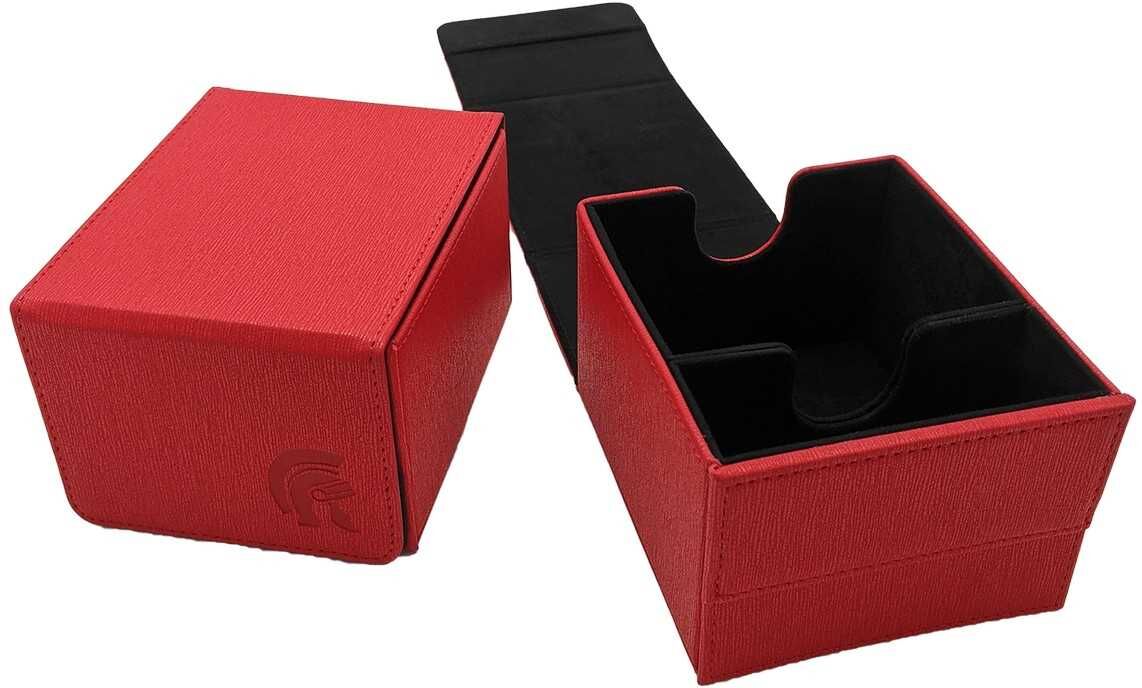
Legion Supplies Legion Sentinel Deck Box 80 - Red - Card Game AccessoriesProtect your card collection with the Legion Sentinel Deck Box 80 in red. This compact deck box is designed for trading card games and other standard-sized card collections, keeping your cards together and protected between games. It holds up to 80 double-sleeved cards, making it suitable for organized play and everyday deck storage. The durable textured vinyl exterior is designed for regular handling, while the soft, smooth interior helps prevent snagging on card sleeves. A strong magnetic lid with a stepped closure ensures the box stays shut, and easy-grip cut-outs provide convenient card access. The compact format makes it easy to store and transport your deck, and the red finish makes it easy to identify in a collection.15,99 £*Shipping: 3,95 £Secure redirect to the provider
-
Legion Supplies Legion Sentinel Deck Box 80 - Green - Card Game AccessoriesProtect your trading-card deck with the Legion Sentinel Deck Box 80 in green. Its durable textured vinyl exterior helps shield cards from everyday knocks while the soft interior is gentle on cards and sleeves. Holds up to 80 double-sleeved cards for organized play. Magnetic lid with stepped closure keeps the box securely shut. Wraparound design provides protection around the deck. Easy-grip cut-outs at the front for quick card access.15,99 £*Shipping: 3,95 £Secure redirect to the provider
-
What is the difference between reflection and scattering?
Reflection occurs when light bounces off a surface at the same angle it hits it, resulting in a clear image. Scattering, on the other hand, occurs when light is dispersed in different directions by particles or irregularities in a medium, resulting in a diffuse or hazy appearance. In reflection, the light maintains its original intensity and color, while in scattering, the light may lose intensity and change color due to the interaction with the medium. **
-
What causes the photoelectric effect: absorption or scattering?
The photoelectric effect is caused by absorption of photons by electrons in a material, rather than scattering. When a photon with sufficient energy is absorbed by an electron in a material, it can transfer enough energy to the electron to liberate it from the material, causing the photoelectric effect. Scattering, on the other hand, involves the redirection of photons by particles in a material, but it does not result in the ejection of electrons from the material. **
-
What tools, materials, and equipment do teachers work with?
Teachers work with a variety of tools, materials, and equipment in their daily work. Some common tools include whiteboards, markers, and projectors for delivering lessons. Materials such as textbooks, worksheets, and manipulatives are used to support student learning. Equipment like computers, printers, and audio-visual devices are also essential for creating engaging lessons and activities. Overall, teachers rely on a combination of traditional and modern tools to effectively educate their students. **
-
Why is the Rutherford experiment called the scattering experiment?
The Rutherford experiment is called the scattering experiment because it involved firing alpha particles at a thin gold foil and observing how they scattered after hitting the foil. This scattering of alpha particles provided crucial evidence for the existence of a small, dense nucleus within the atom, as most of the alpha particles passed through the foil with little deflection, but a small fraction were scattered at large angles. This unexpected scattering pattern led to the development of the nuclear model of the atom and revolutionized our understanding of atomic structure. **
* All prices are inclusive of VAT and, if applicable, plus shipping costs. The offer information is based on the details provided by the respective shop and is updated through automated processes. Real-time updates do not occur, so deviations can occur in individual cases. ** Note: Parts of this content were created by AI.